Energy Process Engineering,Department of Chemical
Engineering, Faculty of Engineering,Tohoku University












Research Activities
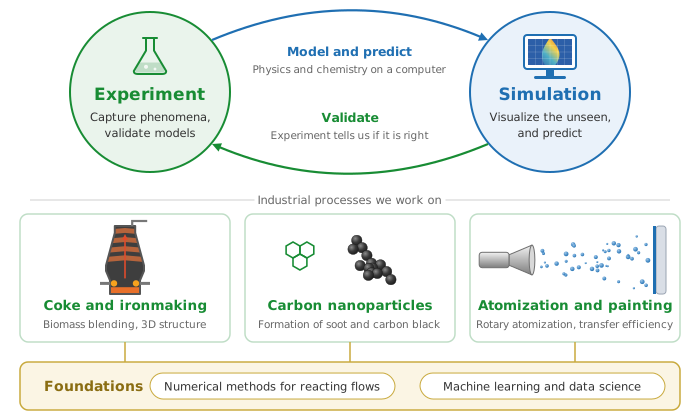
In the Energy Process Engineering group we study the phenomena that occur in energy and materials production processes, working with experiment and numerical simulation as a matched pair. We capture a phenomenon by experiment, describe its physics and chemistry as a model, and reproduce and predict it on a computer. That loop is how we contribute to improving equipment and to predicting product quality. Our subjects are real industrial processes: metallurgical coke, carbon black and soot, spray painting, and combustion furnaces.
How we work
Contributing to industry from both experiment and theory
We understand a phenomenon through experiment, and we turn that understanding into theory with the help of computers. That is how we contribute to improving equipment and to predicting the quality of the material produced. The inside of a furnace, and the course of a reaction that proceeds in milliseconds, cannot be seen by experiment alone; simulation is what makes them visible. Conversely, only experiment can tell us whether a simulation is right. Being able to do both with our own hands is what characterises this group.
Acquiring a feel for chemical engineering
Chemical engineering touches a very wide range of industry, and its value there is high. We aim to train people who can carry out both experiment and simulation, and who have a feel for the strengths and weaknesses of each. Much of our work is done jointly with companies and research institutes in Japan and abroad, which gives our students direct contact with the problems of real processes.
Coke and ironmaking
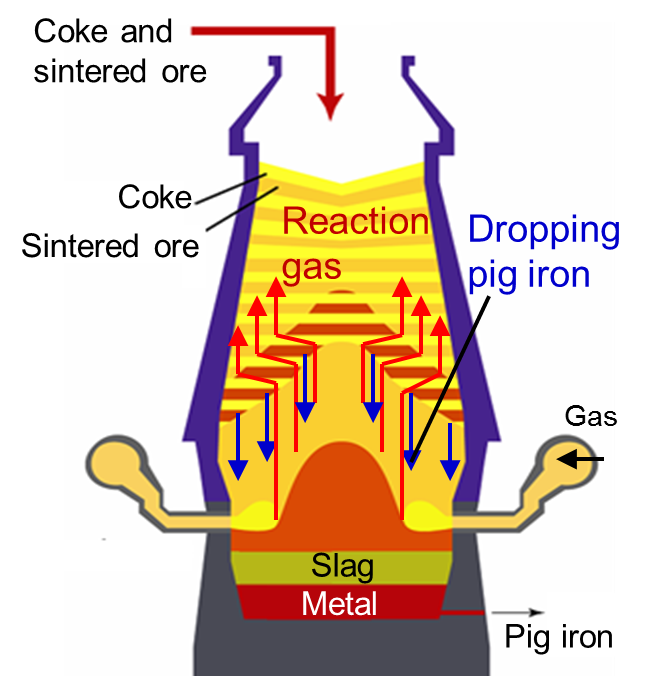
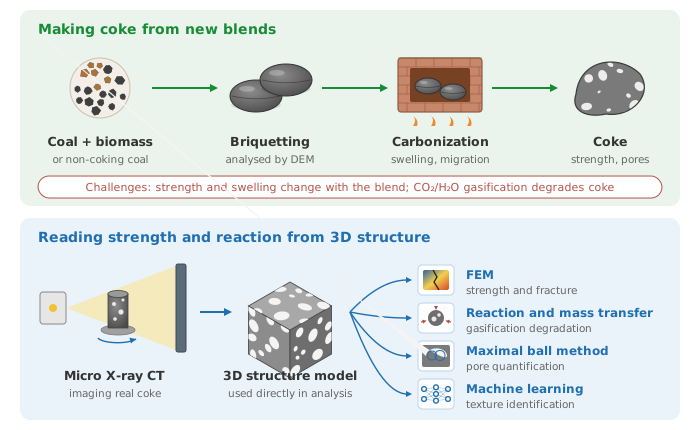
Coke charged into a blast furnace is a reductant and a heat source, and at the same time it works as a spacer that keeps the burden bed permeable to gas and liquid. As the pressure to cut CO2 emissions from ironmaking grows, we are working on the production of coke blended with biomass. We also study coke with a high fraction of non-coking coal, from the point of view of widening the usable feedstock range. In either case the key question is how the blended component migrates during coking and how it changes the structure and the strength. On top of that, gasification by CO2 and H2O inside the furnace keeps altering the structure itself.
Our approach
- Measure the swelling behaviour and the strength of formed coke blended with torrefied biomass, through the forming and coking stages
- Take the three-dimensional structure of real coke measured by micro X-ray CT directly as the analysis object, and relate pore structure and non-adhesive grain boundaries to strength by the finite element method
- Evaluate the structural change and strength loss caused by CO2 and H2O gasification, from both three-point bending experiments and reaction–mass-transfer simulation
- Simulate the briquetting process by the discrete element method, and track how the blended components migrate and segregate during coking
- Develop the evaluation methods themselves, such as quantifying the pore structure by the maximal ball method and identifying coke texture by machine learning
- Evaluate new feedstock combinations, including ferro-coke containing iron ore
Selected papers
- Y. Matsukawa et al., Experimental Investigation of Expansion during Formation Process of Formed Coke Blending with Torrefied Biomass, ISIJ International, 63(9), 1557–1566 (2023) DOI
- Y. Numazawa et al., Large-scale simulation of gasification reaction with mass transfer for metallurgical coke: Model development, Fuel, 266, 117080 (2020) DOI
- Y. Ono et al., Experimental and numerical study on degradation behavior of coke with CO2 or H2O gasification reaction at high temperature, Fuel, 309, 122061 (2022) DOI
- Y. Matsukawa et al., Migration of inert materials during coking of molded coal, Chemical Engineering Journal Advances, 16, 100526 (2023) DOI
- Y. Matsukawa et al., Three-Dimensional Evaluation of Internal Structure of Coke Made by Blending Non-coking Coal Using X-ray Computed Tomography, ISIJ International, 64(9), 1367–1375 (2024) DOI
- D. Igawa et al., Characterization of the Three-dimensional Pore Structure of Coke Using the Maximal Ball Method, ISIJ International, 65(3), 360–371 (2025) DOI
Carbon nanoparticles (soot and carbon black)

A tyre and carbon black (illustrative image)
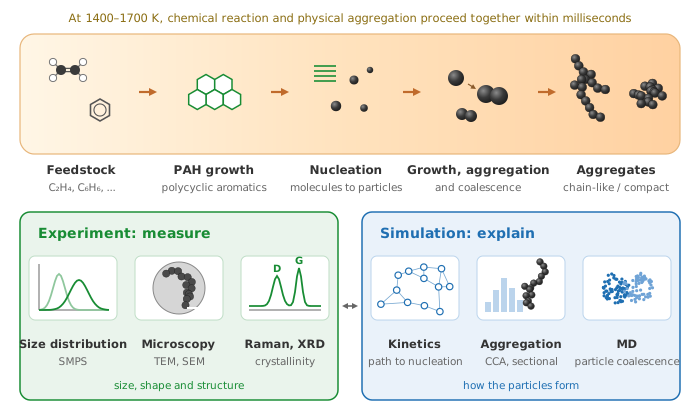
About 25 wt% of carbon black is added to a tyre as a reinforcing agent, and its morphology — whether the aggregates are chain-like or compact — governs the performance of the tyre and therefore the fuel economy of the vehicle. Yet the production process is extremely complex: chemical reaction and the physical aggregation of particles proceed at the same time, at high temperature and within a reaction time of the order of milliseconds. We study the formation mechanism of soot and carbon black from hydrocarbon pyrolysis, by experiment and simulation together, aiming at a technology that can produce a chosen morphology on purpose.
Our approach
- Pyrolyse hydrocarbons in a temperature-controlled furnace, and measure the size distribution with a scanning mobility particle sizer (SMPS), the morphology by electron microscopy, and the crystalline structure by Raman spectroscopy and X-ray diffraction
- Follow, with a detailed kinetic mechanism, the pathway by which polycyclic aromatic hydrocarbons (PAH) become particle nuclei, and clarify how the feedstock composition and the H/C ratio affect the size distribution
- Compute aggregate morphology and size distribution with cluster–cluster aggregation (CCA) and two-dimensional sectional models
- Reveal, by molecular dynamics, the molecular-level mechanism and the characteristic time of the coalescence of two primary particles
- Study the growth of new forms of solid carbon, such as film-like carbon, produced by hydrocarbon pyrolysis in a thermal plasma
Selected papers
- Y. Matsukawa et al., Reaction pathway for nascent soot in ethylene pyrolysis, Combustion and Flame, 167, 248–258 (2016) DOI
- Y. Araki et al., Influence of aliphatic side chains of aromatic hydrocarbons on soot formation: Experimental and numerical investigation, Combustion and Flame, 194, 195–205 (2018) DOI
- Y. Matsukawa et al., Molecular dynamics simulation of coalescence behavior of carbon nanoparticle, Chemical Engineering Research and Design, 201, 209–217 (2024) DOI
- Y. Matsukawa et al., Numerical investigation of the coalescence behavior of carbon nanoparticle based on the cluster-cluster aggregation model considering the experimental coalescence characteristic time, Chemical Engineering Journal, 480, 148114 (2024) DOI
- S. Tanoguchi et al., Effect of H/C ratio of feedstock composition on particle size distribution of soot in C2 hydrocarbon pyrolysis, International Journal of Hydrogen Energy, 58, 1020–1029 (2024) DOI
- Y. Matsukawa et al., Pyrolysis products of C2 hydrocarbons using thermal plasma, Cleaner Chemical Engineering, 10, 100121 (2024) DOI
Atomization and spray painting
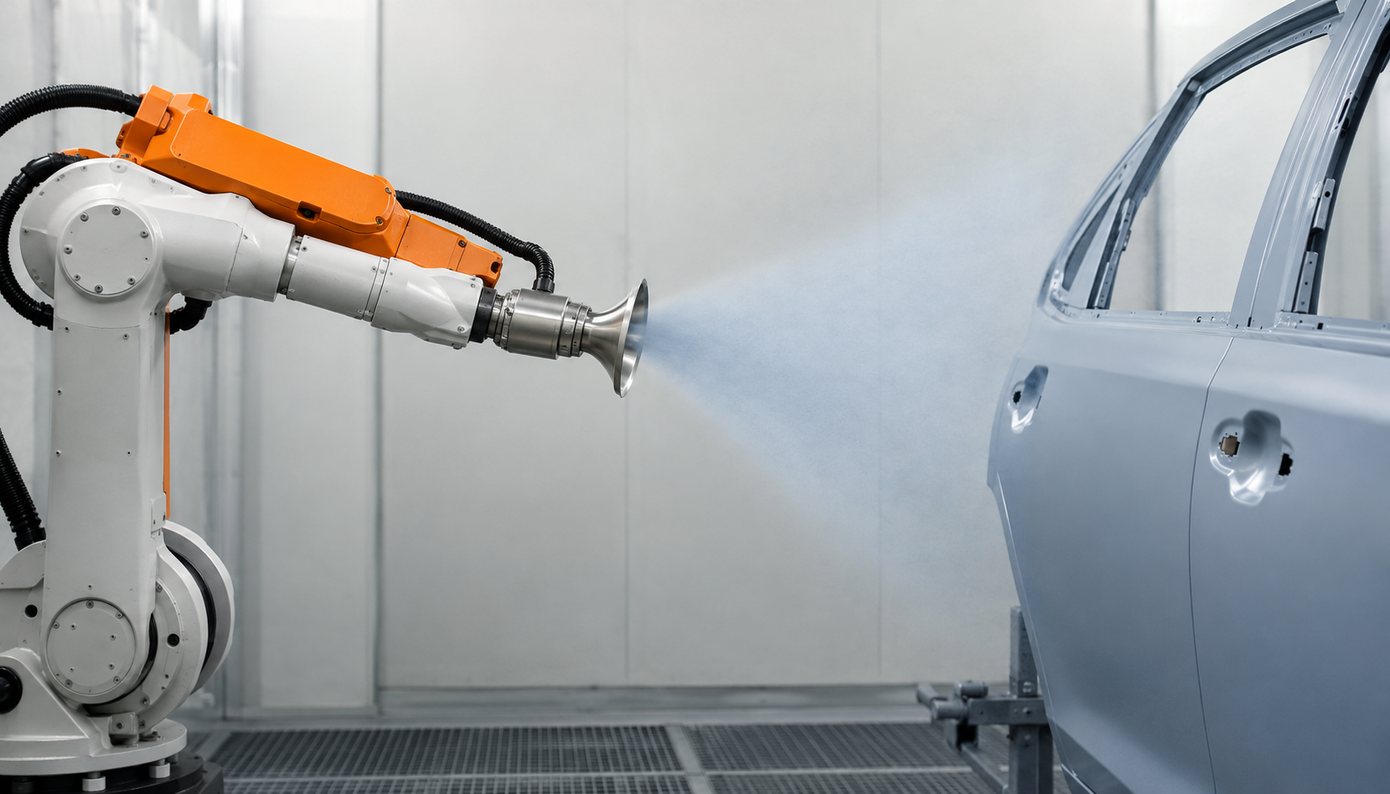
Spray painting of a car body with a rotary atomizer (illustrative image)
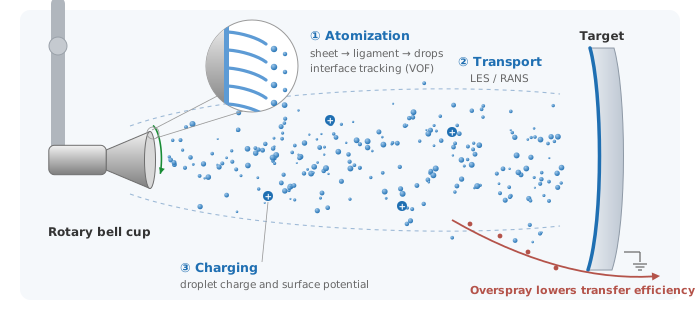
Automotive painting uses a high-speed rotary bell-cup atomizer, but part of the paint never reaches the target and is lost as overspray, which worsens the working environment, pollutes the surroundings and raises cost. Identifying what controls the transfer efficiency is the problem.
Our approach
- Reproduce the breakup of the liquid sheet and ligaments leaving the bell cup by interface-tracking (VOF) simulation, and clarify the role of the jet curvature caused by centrifugal and Coriolis forces
- Simulate the spray transport from the bell cup to the target by LES and by RANS, and compare how accurately each predicts the transfer efficiency and the overspray
- Measure the charge and the surface potential of droplets in electrostatic painting, and clarify the charging and discharging characteristics
- Evaluate how the shear-thinning viscosity of the paint, as a non-Newtonian fluid, affects the deformation of the liquid film
Selected papers
- Y. Matsushita et al., A spray painting simulation using high-speed rotary atomizer—Model development and comparison of LES and RANS—, Results in Engineering, 21, 101697 (2024) DOI
- T. Soma et al., Numerical Investigation of Liquid Jet Breakup in Rotary Atomizer, Chemical Engineering & Technology, 48(7), e70043 (2025) DOI
- R. Jin et al., A study on the measurement of charge and surface potential of charged liquid droplets in spray painting, International Journal of Plasma Environmental Science and Technology, 19(2), e02012 (2025) DOI
Numerical methods for reacting flows
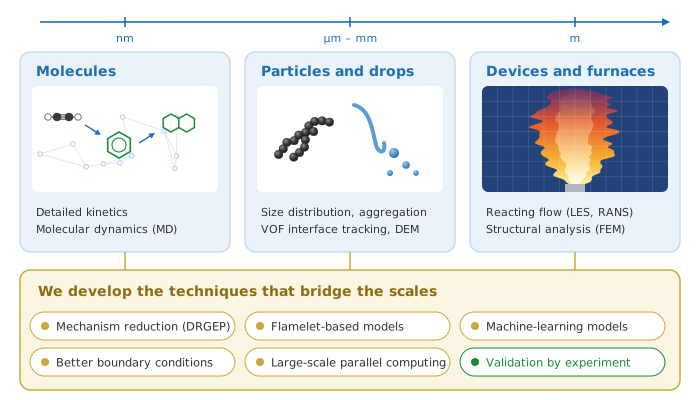
Every one of the themes above needs the same underlying capability: to solve a flow with chemical reaction accurately and at a realistic computational cost. Beyond applying simulation to each subject, we also develop and improve the numerical methods themselves.
Our approach
- Assess the flamelet/progress-variable approach and the flamelet-generated manifolds method, and apply them to large eddy simulation of pulverized-coal combustion
- Reduce detailed kinetic mechanisms by the DRGEP method, with a new way of determining the interaction coefficients that accounts for the time dependence of the reaction rates
- Assess and improve the accuracy of detailed kinetic mechanisms for aromatic formation during C3–C4 hydrocarbon pyrolysis
- Improve the fundamentals of the numerical method itself: outflow boundary conditions in a variable-density field, and the treatment of the source term in the energy equation written with temperature as the variable
- Develop efficient communication strategies for parallel computation based on domain decomposition
Selected papers
- S. Akaotsu et al., Application of flamelet/progress-variable approach to the large eddy simulation of a turbulent jet flame of pulverized coals, Advanced Powder Technology, 31(10), 4253–4274 (2020) DOI
- Y. Matsukawa et al., DRGEP-based mechanism reduction considering time dependency of reaction rate, Chemical Engineering Journal Advances, 16, 100546 (2023) DOI
- Y. Matsukawa et al., Modification of Detailed Kinetic Mechanism for Aromatic Hydrocarbon Formation during C3–C4 Hydrocarbon Pyrolysis, Journal of Chemical Engineering of Japan, 56(1), 2247031 (2023) DOI
- Y. Ono et al., Consideration on Accuracy of Numerical Analysis of Solid–Gas Two-Phase Flow with Reaction Using Energy Conservation Equation with Temperature as a Variable, Journal of Chemical Engineering of Japan, 56(1), 2284176 (2023) DOI
Machine learning and data science
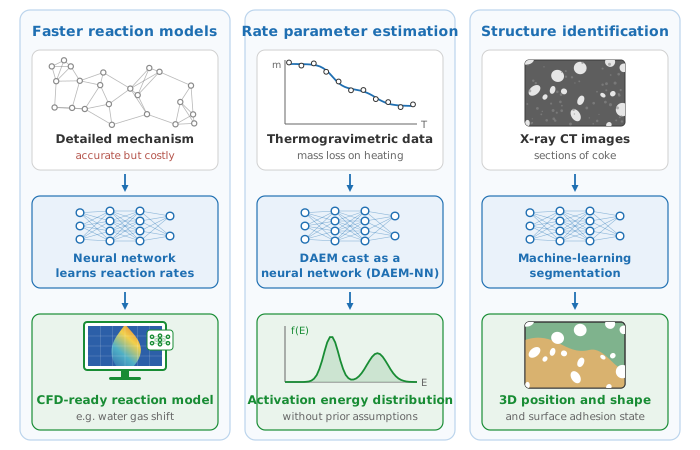
A detailed kinetic mechanism is accurate but expensive, and cannot be embedded in CFD as it stands. In evaluating the reactivity of a solid fuel, unknown kinetic parameters have to be estimated from measured data. We use neural networks and other machine-learning tools to bridge accuracy and computational cost, and model and data.
Our approach
- Recast the estimation of the kinetic parameters of the distributed activation energy model (DAEM) as the training problem of a three-layer neural network (DAEM-NN), so that the parameters of a parallel reaction system can be estimated without any prior assumption
- Propose a new criterion for choosing the hyperparameters of DAEM-NN
- Train a neural network on reaction-rate data generated from a detailed kinetic mechanism, and obtain a model of the water gas shift reaction that is both cheap and accurate
- Identify the three-dimensional position, shape and surface adhesion state of the coke substrate by machine learning
- Combine image processing with structural evaluation, for instance in the image recognition of defects in coke
Selected papers
- S. Wakimoto et al., Neural network estimation of kinetic parameters in distributed activation energy model (DAEM) without a priori assumptions for parallel reaction system, Fuel, 343, 127836 (2023) DOI
- S. Wakimoto et al., New criteria to select reasonable hyperparameters for kinetic parameter estimation in distributed activation energy model (DAEM) by using neural network, Chemical Engineering Science, 285, 119597 (2024) DOI
- K. Yamaguchi et al., Modeling of water gas shift reaction using neural network trained on detailed kinetic mechanisms, Chemical Engineering Journal, 491, 151659 (2024) DOI
Tools and facilities
Experiment
- Temperature-controlled pyrolysis furnace, carbon black production furnace, thermal plasma reactor
- Scanning mobility particle sizer (SMPS), transmission and scanning electron microscopes, Raman spectroscopy, X-ray diffraction
- Micro X-ray CT for the three-dimensional structure of coke and coal briquettes, three-point bending tests for strength
- High-speed camera for atomization, measurement of droplet charge and surface potential
Simulation
- In-house codes for reacting flows (LES and RANS), interface tracking by the VOF method
- Detailed kinetic mechanisms and their reduction, flamelet-based models
- Size distribution and morphology (sectional method, cluster–cluster aggregation, Monte Carlo)
- Structural and fracture analysis by the finite element method, powder behaviour by the discrete element method
- Molecular dynamics, and modelling with neural networks
- Large-scale parallel computing by domain decomposition
Publications
A full list of our papers is on the Journal Articles page, conference presentations are on the Conference Proceedings page, and theses are listed on the Thesis page.
Links











Copyright © 2014 Aoki Laboratory. All Rights Reserved.